PRISM
Photorealistic Reconstruction
& Intrinsic Scene Modeling
1Imperial College London · 2Adobe Research
*Work done during an internship at Adobe.
Overview
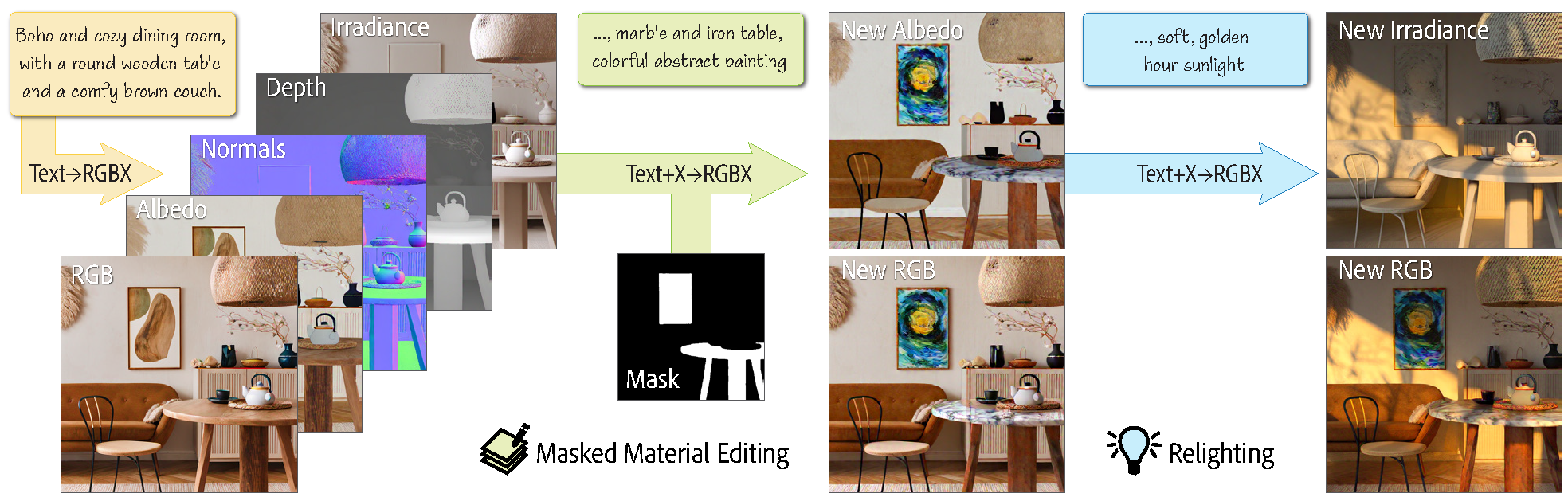
Contributions
Unified Multi-task Model
A single model for inverse and forward rendering, and text-to-RGBX generation that demonstrates strong generalization to diverse real-world scenes.
Joint RGBX Generation
Joint generation of intrinsic layers and RGB images for improved cross-modality alignment, addressing ambiguity between geometry and material properties.
Versatile Editing
Competitive performance across intrinsic decomposition and diverse editing applications including text-guided relighting and local material editing.
Abstract
Method
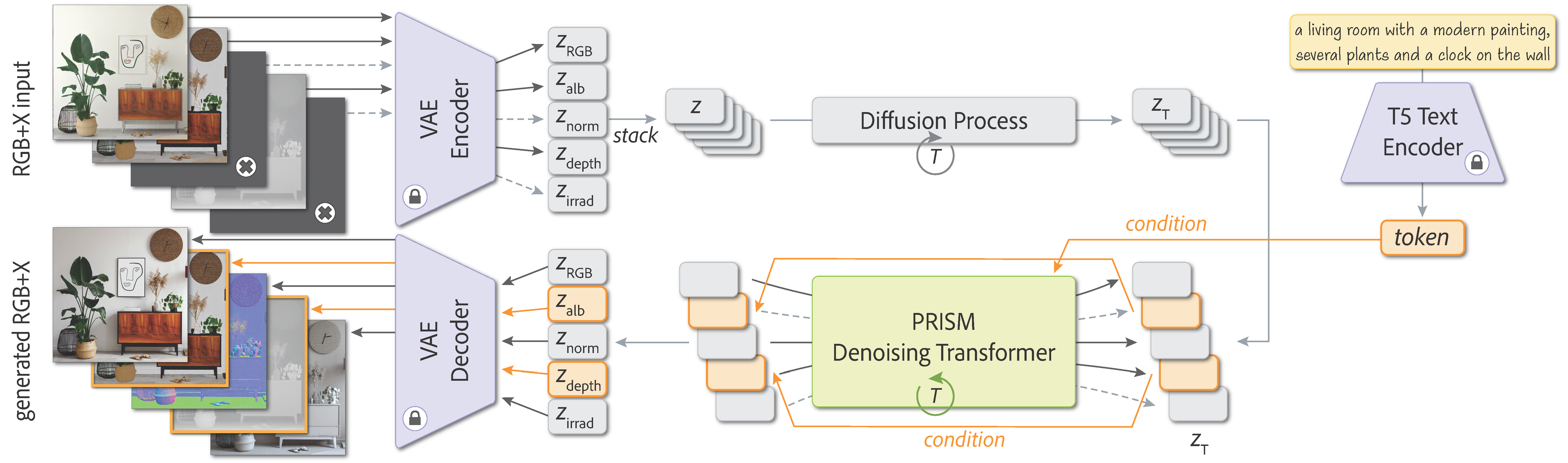
Results
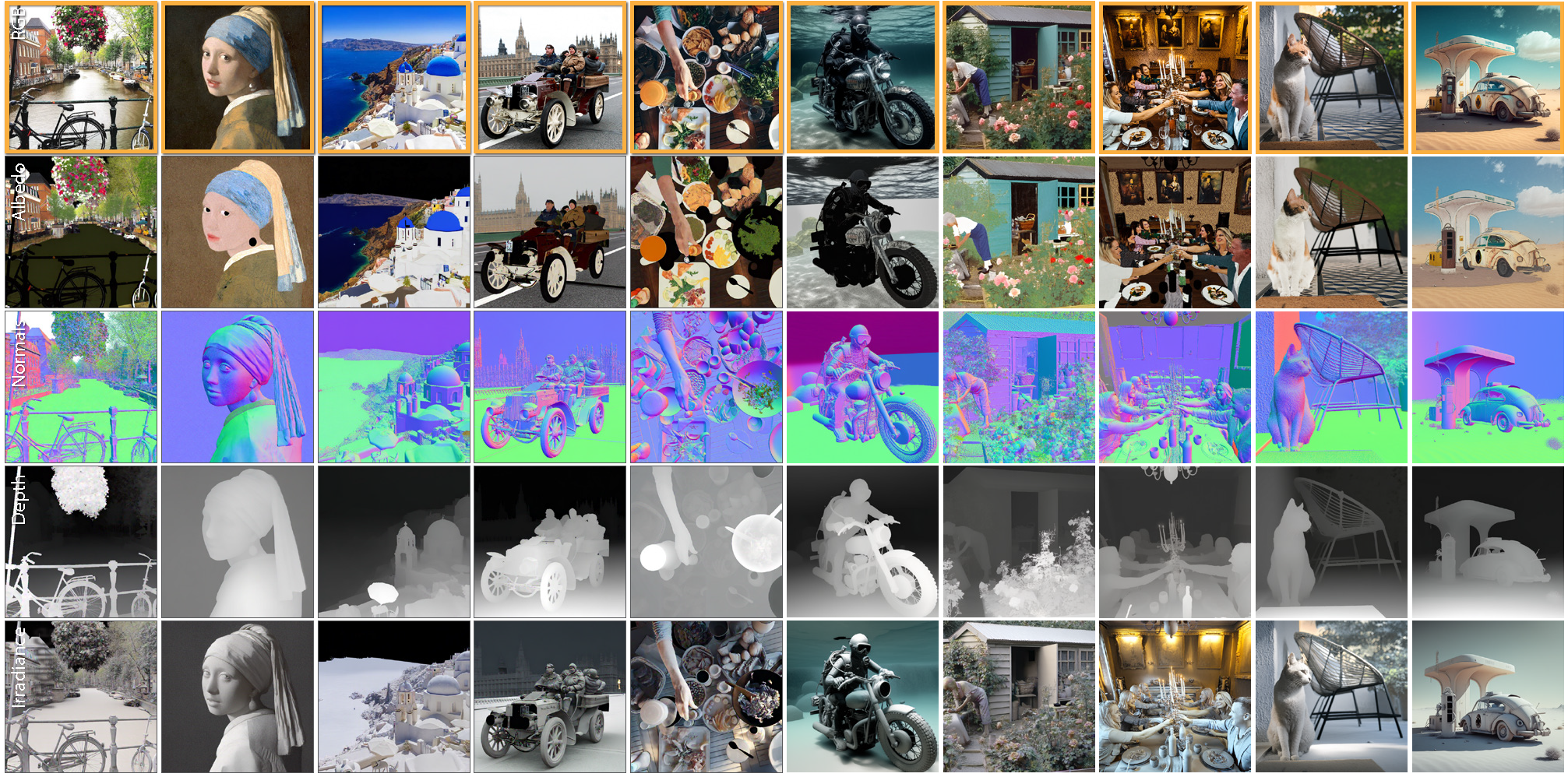
PRISM supports multiple generation modes in a single model: text-to-RGBX, RGB-to-X decomposition, and X-to-RGBX conditional generation. Any subset of text, RGB, and X inputs can be combined to jointly generate RGBX images.
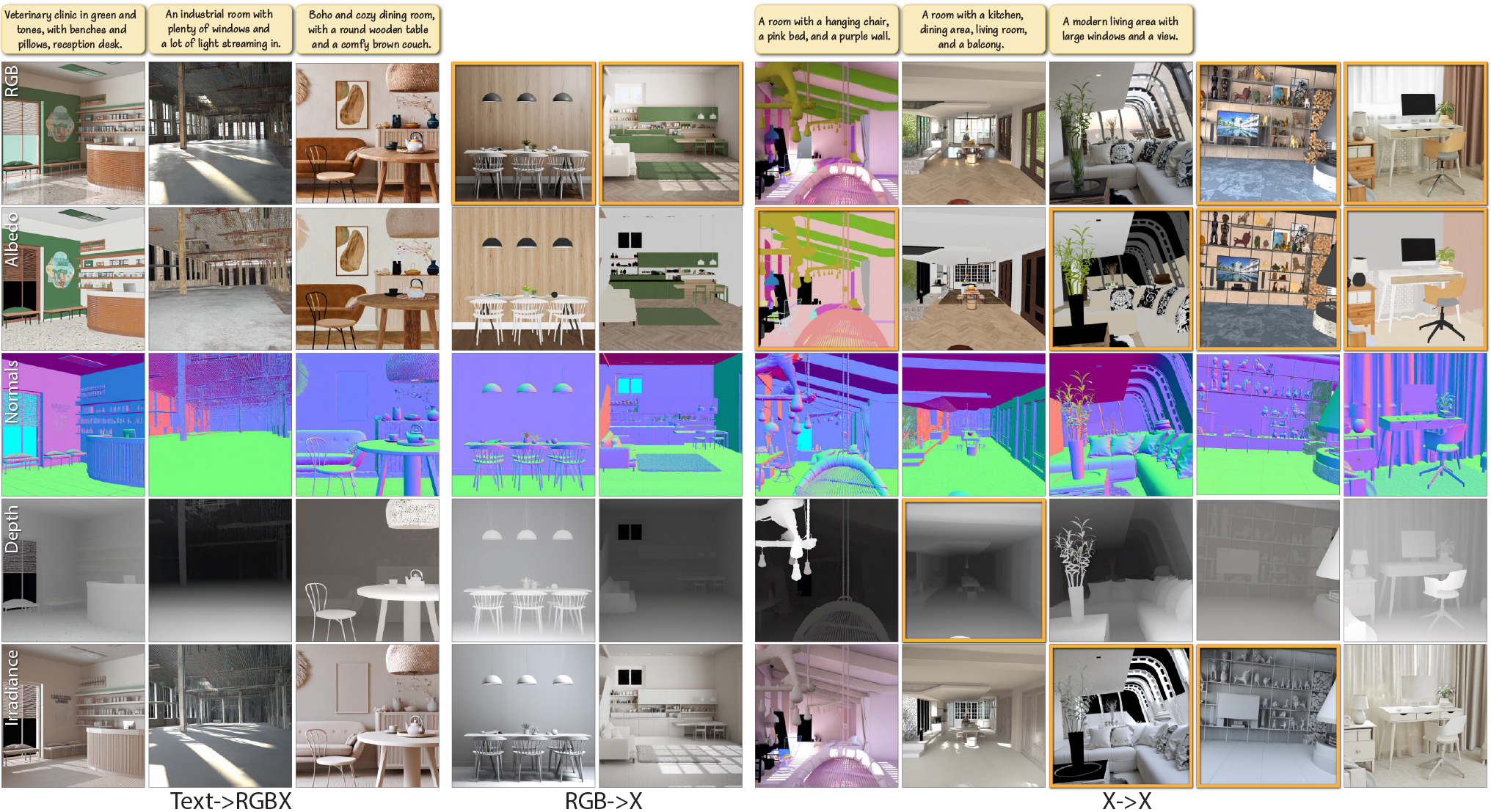
Overview of operation modes and their applications
Generate RGB images along with albedo, normals, depth, and irradiance from text descriptions alone.
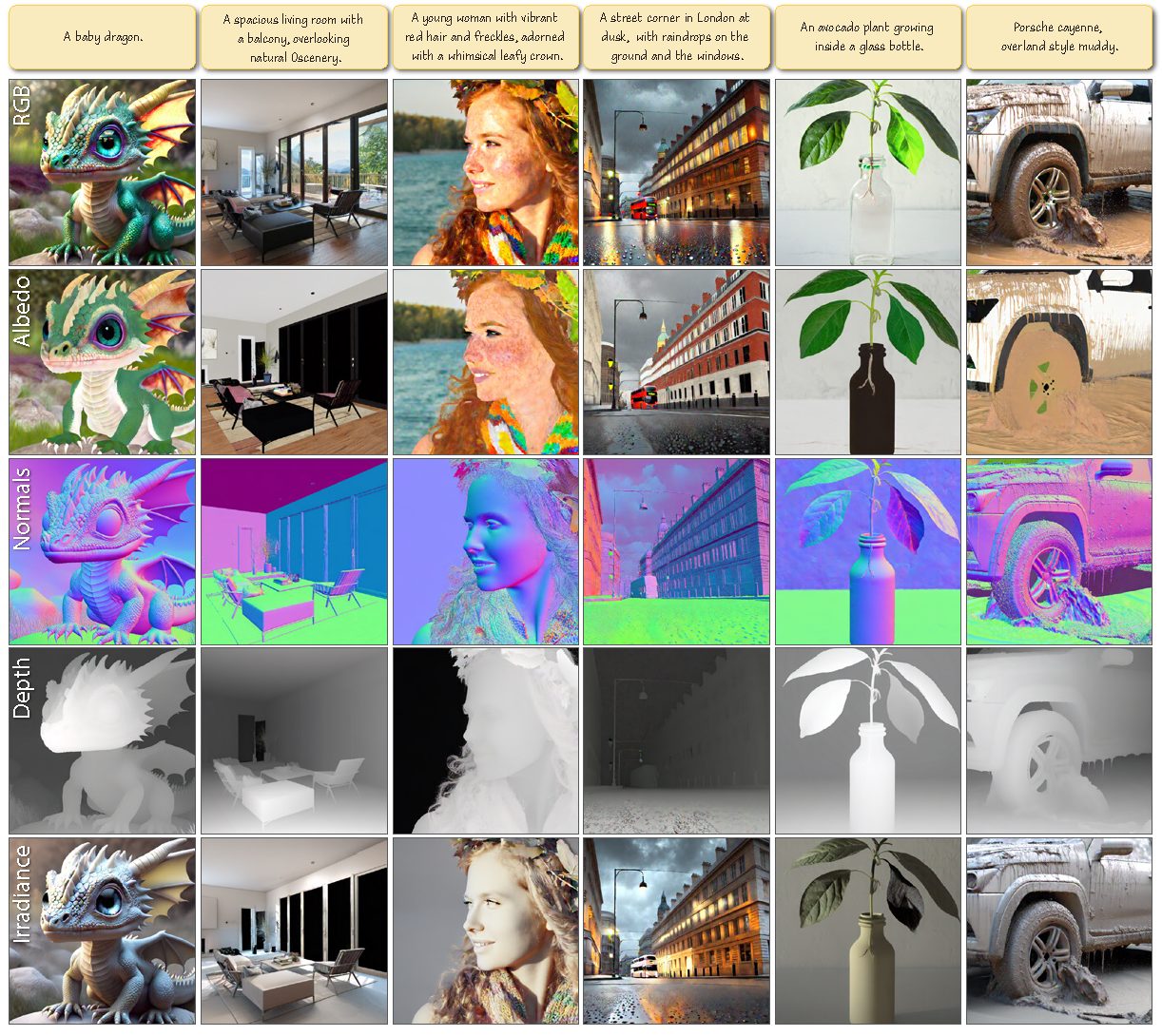
Diverse text prompts generating consistent RGB and intrinsic representations
Given an RGB input, PRISM decomposes it into albedo, surface normals, depth, and irradiance — matching or outperforming state-of-the-art methods while being a single unified model.
Comparison with State-of-the-Art
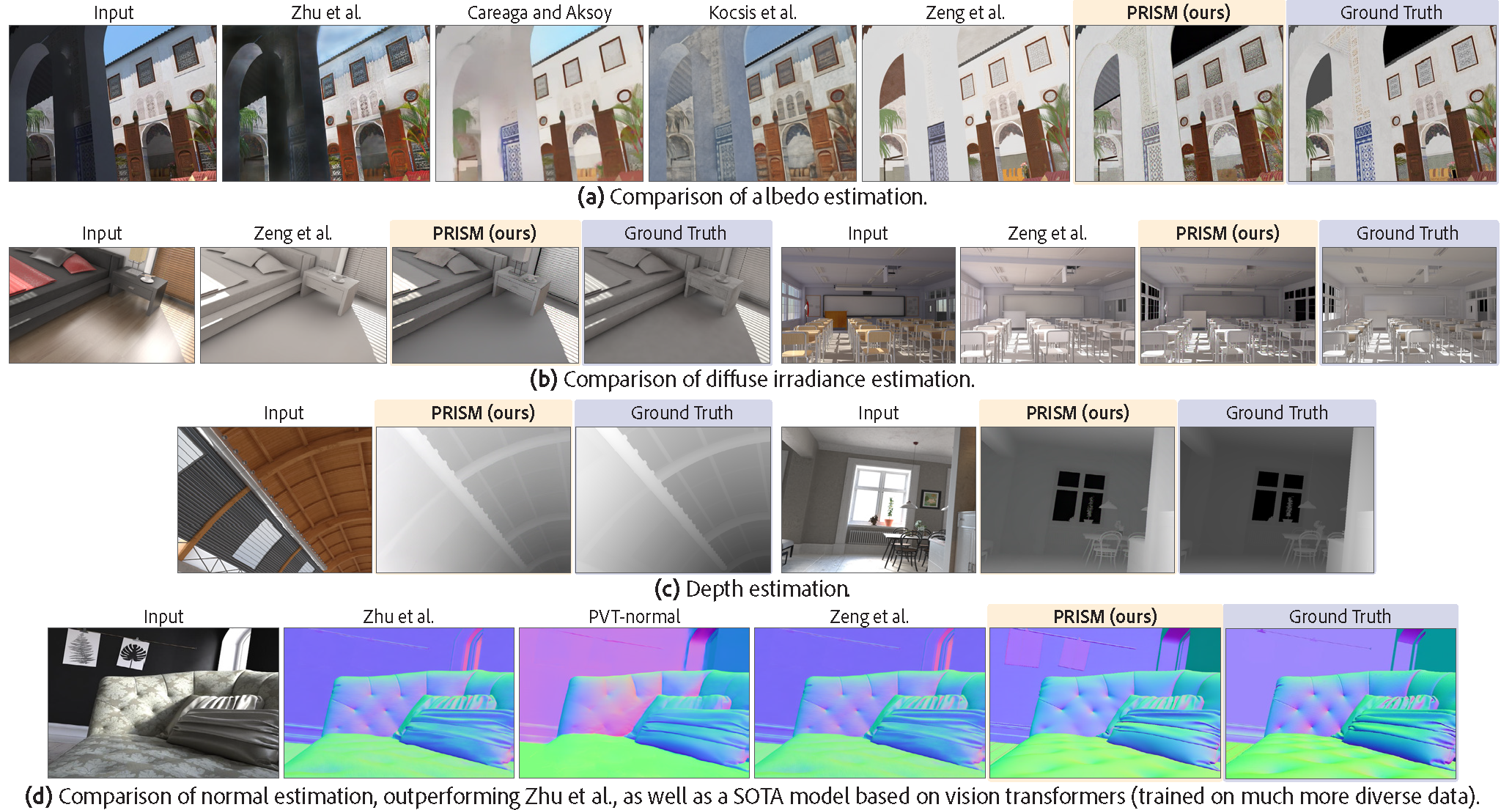
Visual comparison against baseline methods on synthetic datasets
Decompose an input image, then condition generation on all intrinsic layers except irradiance with a new lighting text prompt. Geometric and material properties are preserved while generating plausible new lighting, including shadows, specular highlights, and indirect illumination.
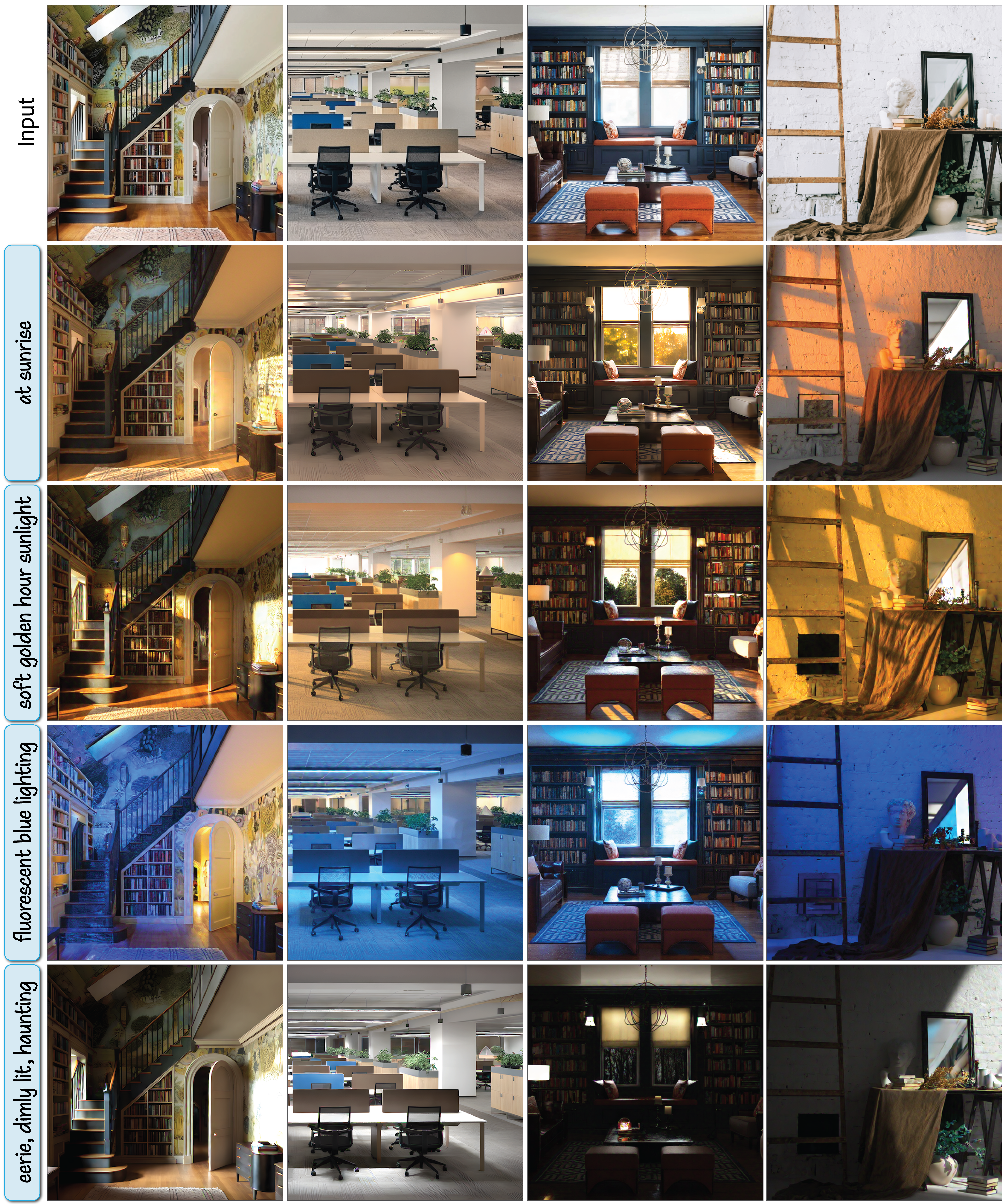
Comparison with State-of-the-Art
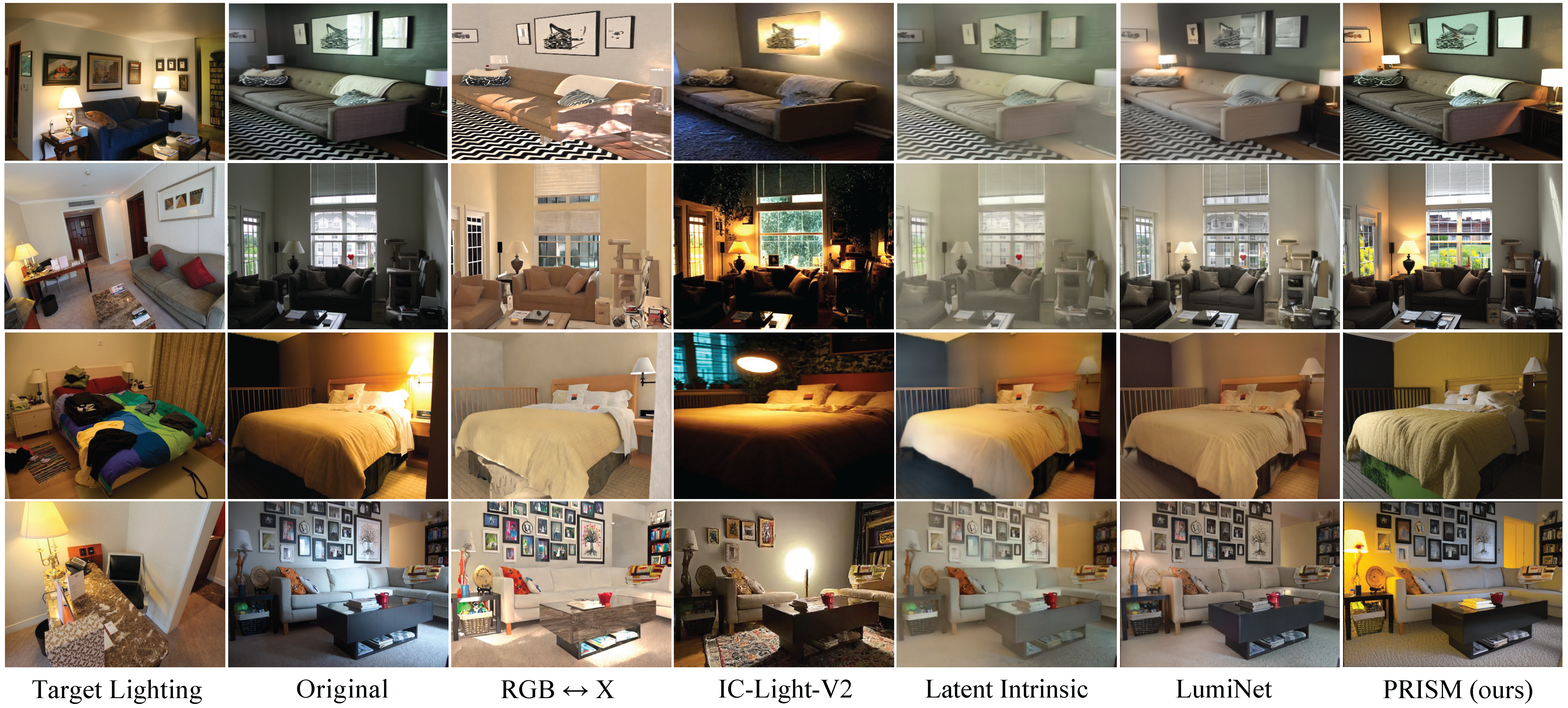
Comparison with RGB↔X, IC-Light-V2, Latent Intrinsic, and LumiNet
Masked conditioning lets PRISM edit specific objects while preserving lighting consistency. A mask and text prompt describing desired material properties generates realistic appearance changes while maintaining scene identity.
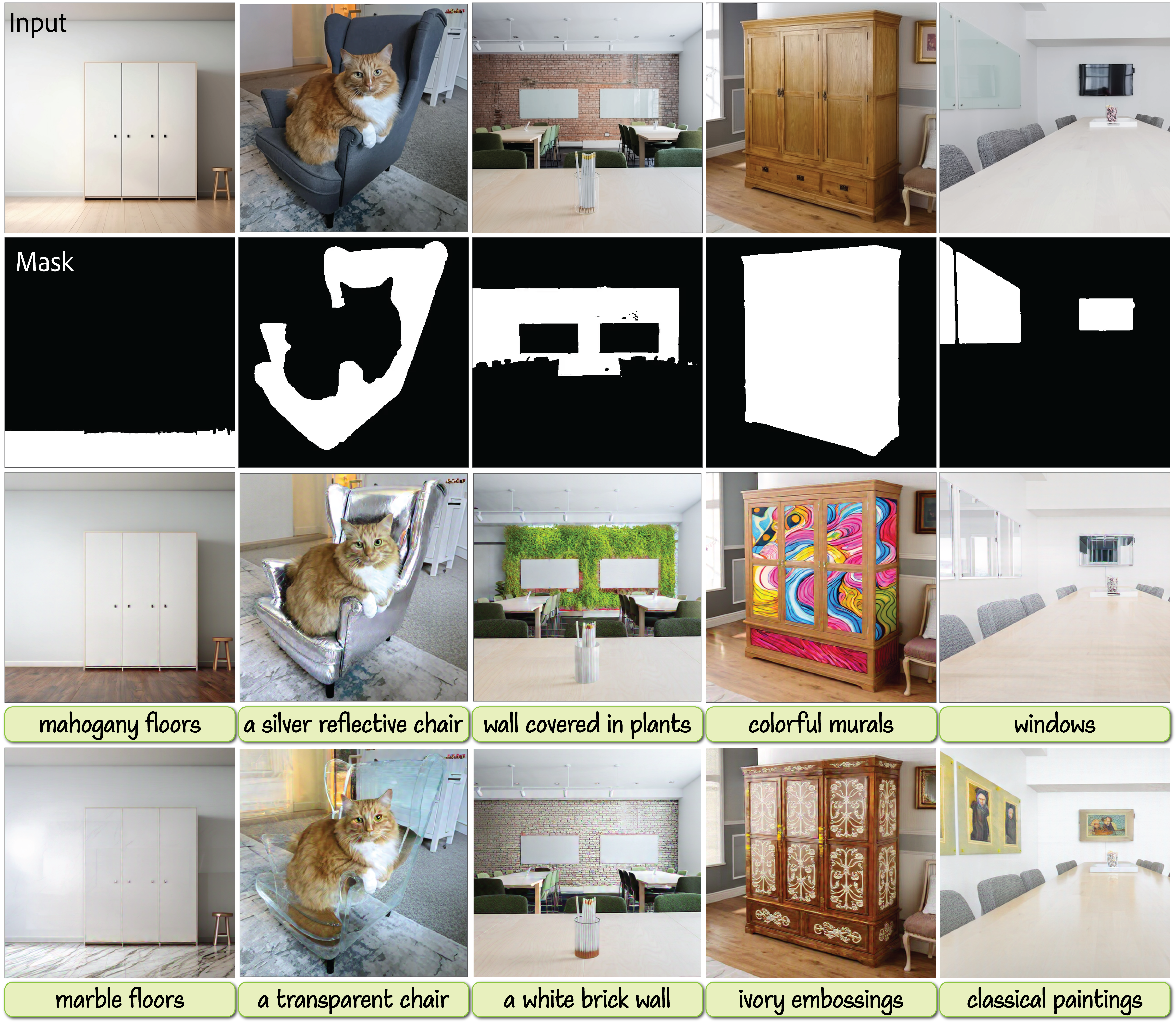
Appearance changes on masked objects with consistent lighting
BibTeX
@inproceedings{Dirik2025PRISM,
        title = {PRISM: A Unified Framework for Photorealistic Reconstruction and Intrinsic Scene Modeling},
        author = {Dirik, Alara and Wang, Tuanfeng and Ceylan, Duygu and Zafeiriou, Stefanos and Fr{\"u}hst{\"u}ck, Anna},
        booktitle = {Proceedings of the International Conference on Pattern Recognition (ICPR)},
        year = {2026}
}